
A new way to estimate the economic impacts in Canada across all industries
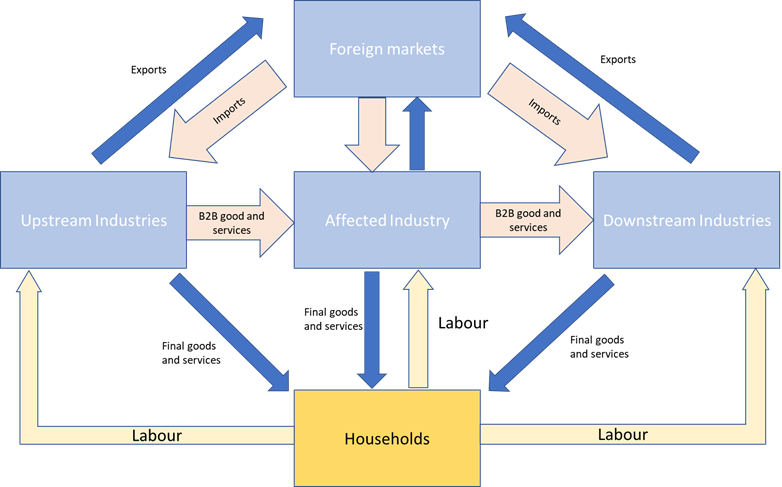
Envelope Economics has developed the Canadian Labour-restricted Input-Output Model (CLIO Model) to investigate how productivity shocks in one industry affect the broader economy. Productivity shocks often arise from government regulation, changes in industry technology, or economies of scale.
The CLIO Model is based on theoretical research from renowned economists such as Daron Acemoglu and Charles Jones, who have investigated how distortions affect economic networks. Technically speaking, the CLIO Model is a neoclassical closure, IO model that may be used to estimate long-run economic impacts.
The CLIO Model is based on Statistics Canada’s supply-and-use tables and labour data. It takes advantage of over 50,000 data points that describe Canada’s interindustry, trade and consumption network linkages.
Advantages of the CLIO Model
The model has a vast array of advantages over the typical input-output multipliers available through Statistics Canada.
- The CLIO Model may estimate the impact of any number of regulations, government programs, innovations or “technology impacts” on both the industry and entire economy.
- The results from the CLIO Model are more realistic in the long term than those from a traditional IO model, because it assumes that Canada’s labour supply is fixed. Traditional input-output models assume that resources are available in unlimited quantities.
- The economic impacts measured are more complex and non-linear. They are dynamic impacts that take into account how businesses across the economy will adapt and shift from Canadian to international suppliers of inputs.
- The model balances trade based on the use of imported goods as intermediate inputs and final goods.
Specific applications of the CLIO Model
- Regulatory changes: Regulations change what business may use in production or require them to divert employees to regulatory compliance measures.
- New technology approvals: The government may approve/withdraw different production technologies that alter business behaviour.
- Industry specific programs: Government often provide incentives/disincentives to specific industries that will change their use of different inputs (e.g. a fuel tax or a new investment incentive).
- Long-term impacts of R&D and productivity: The model can estimate the impacts of continued productivity improvements in an industry on the economy.
- Terms of trade shocks: For example, a loosening of import regulations in the U.S. for a specific industry.
- Classic IO shocks and footprint analysis: The model can also estimate tradition IO shocks that assume unlimited resources and can estimate the broader economic footprint of any indsutry or business.
If you are interested in learning more about the CLIO Model, please contact me.
 Envelope Economics
You must be logged in to post a comment.